 MHQ Hoodies

As an alternative to traditional printing, digital printing is now widely used in the apparel, home textiles, and industrial textiles sectors, and is suitable for a variety of fibers and blended fabrics, including cotton, wool, silk, linen, polyester, and nylon.
But can digital printing really replace screen printing? What are the differences between these two printing processes, and how should one understand and choose between them? Below is a detailed analysis of the technical characteristics and differences between digital printing and screen printing.
Printing refers to the process of applying dyes or inks to create patterns and designs on the surface of fabric. As printing technology has evolved, a diverse range of printing processes—including screen printing, rotary screen printing, roller printing, and digital printing—now coexist. Each printing process has a different scope of application, distinct characteristics, and requires different equipment and consumables.
As a traditional and classic printing technique, screen printing has a wide range of applications and accounts for a relatively large share of the printing industry. However, with the rapid development of digital printing in recent years, many believe it is poised to replace screen printing. What exactly are the differences between these two printing techniques? Here, we analyze the differences between digital printing and screen printing.
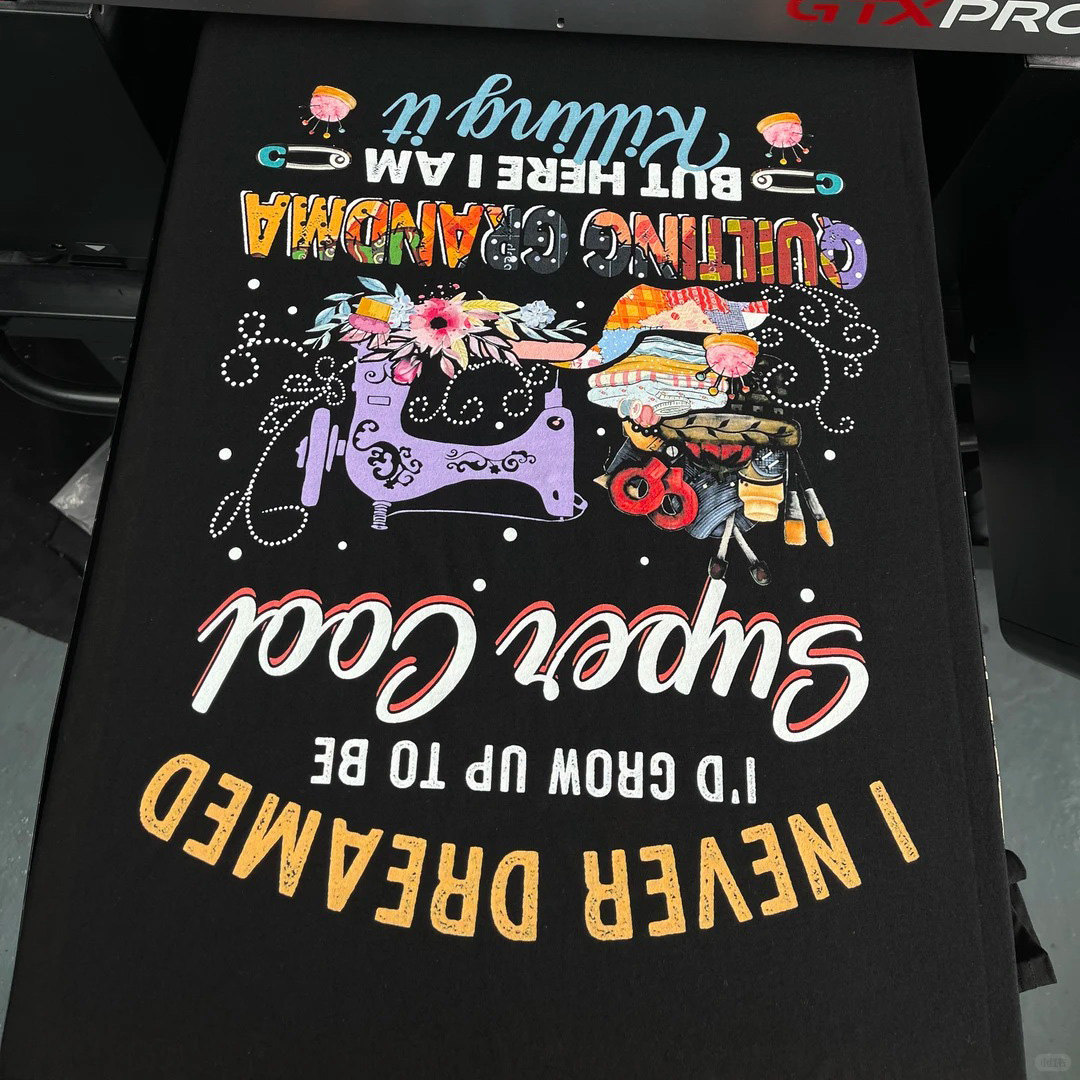
Digital-print black T-shirt
The types of substrates vary only slightly
Digital printing is divided into five categories: acid digital printing, reactive digital printing, pigment digital printing, disperse heat transfer printing, and disperse direct-to-fabric digital printing.
Acid digital printing inks are suitable for fabrics made of protein fibers such as wool and silk, as well as nylon fibers.
Reactive digital printing inks are primarily suitable for digital printing on fabrics such as cotton, linen, viscose, and silk, and can be used for digital printing on natural fiber fabrics including cotton, silk, and wool.
Digital printing pigment inks are suitable for digital inkjet pigment printing on cotton fabrics, silk fabrics, synthetic and blended fabrics, knitted fabrics, sweaters, towels, and blankets.
Digital printing heat transfer inks are suitable for transfer printing on materials such as polyester, non-woven fabrics, and ceramics.
Digital printing direct-to-fabric disperse inks are suitable for digital printing on polyester fabrics, such as decorative fabrics, flag fabrics, and banners.
Traditional screen printing does not offer significant advantages over digital printing in terms of the variety of substrates it can print on. First, traditional screen printing is limited by print width; large-scale industrial digital inkjet printers can achieve print widths of up to 3–4 meters, allowing for continuous printing with no length restrictions, and can even be integrated into an entire production line; second, on certain materials, traditional water-based ink printing cannot achieve optimal performance, necessitating the use of solvent-based inks, whereas digital printing can use water-based inks on any material, thereby avoiding the extensive use of flammable, explosive, and non-environmentally friendly solvents.
Screen printing and digital printing do not differ significantly in the types of substrates they can print on. However, traditional printing is limited in terms of print size; on certain materials, screen printing can only use flammable, explosive, and non-environmentally friendly solvent-based inks.
Digital printing produces more vibrant colors
Color
The greatest advantages of digital printing lie primarily in the precision of its colors and patterns. First, regarding color, digital printing inks are divided into dye-based and pigment-based inks; dye-based inks produce more vibrant colors and are superior to pigment-based inks.
Acid digital printing, reactive digital printing, disperse heat transfer printing, and disperse direct-to-fabric digital printing all use dye-based inks.
Although pigment-based digital printing uses pigments as colorants, it employs nano-sized pigment pastes. With specific inks, as long as dedicated ICC curves are properly configured, color reproduction can reach its peak.
In traditional screen printing, color is determined primarily by the interplay of four-color halftone dots and pre-press ink mixing; consequently, its color reproduction capabilities are inferior to those of digital printing. Furthermore, in digital printing, pigment inks utilize nano-sized pigment pastes, while the dyes in dye-based inks are water-soluble. Even in disperse-type sublimation transfer inks, the colorants are nano-sized.
Patterns
The level of detail in digital printing depends on the characteristics of the inkjet printhead and the printing speed. The smaller the ink droplets produced by the printhead, the higher the print resolution. Epson’s Micro Piezo printheads produce the smallest ink droplets; while industrial printheads produce larger droplets, they can still print images with a resolution of 1440 dpi. Additionally, for a given printer, the faster the printing speed, the lower the print resolution.
Screen printing begins with the creation of a printing plate; errors during this process and the mesh count of the screen both affect the level of detail in the design. In theory, the smaller the mesh aperture, the better; however, standard printing typically uses screens with a mesh count of 100 to 150, while four-color halftone screens use a mesh count of 200. A higher mesh count increases the likelihood of water-based ink clogging the screen, which is a common issue. Additionally, the accuracy of registration during squeegee application has a significant impact on the fineness of the printed design. Machine printing generally yields better results, whereas manual printing is more difficult to control.
Clearly, color and fine graphics are not the strengths of screen printing.
Advantages of screen printing
Its strengths lie in special printing pastes, such as gold, silver, pearlescent, crackle effects, hot-stamped flock effects, and foam-textured finishes.
Screen printing can produce 3D effects.
It is quite difficult to produce white ink for digital printing. Currently, white ink is primarily sourced from imports, but printing on dark fabrics is impossible without white ink. This is the key challenge that must be overcome for digital printing to become widely adopted in China.
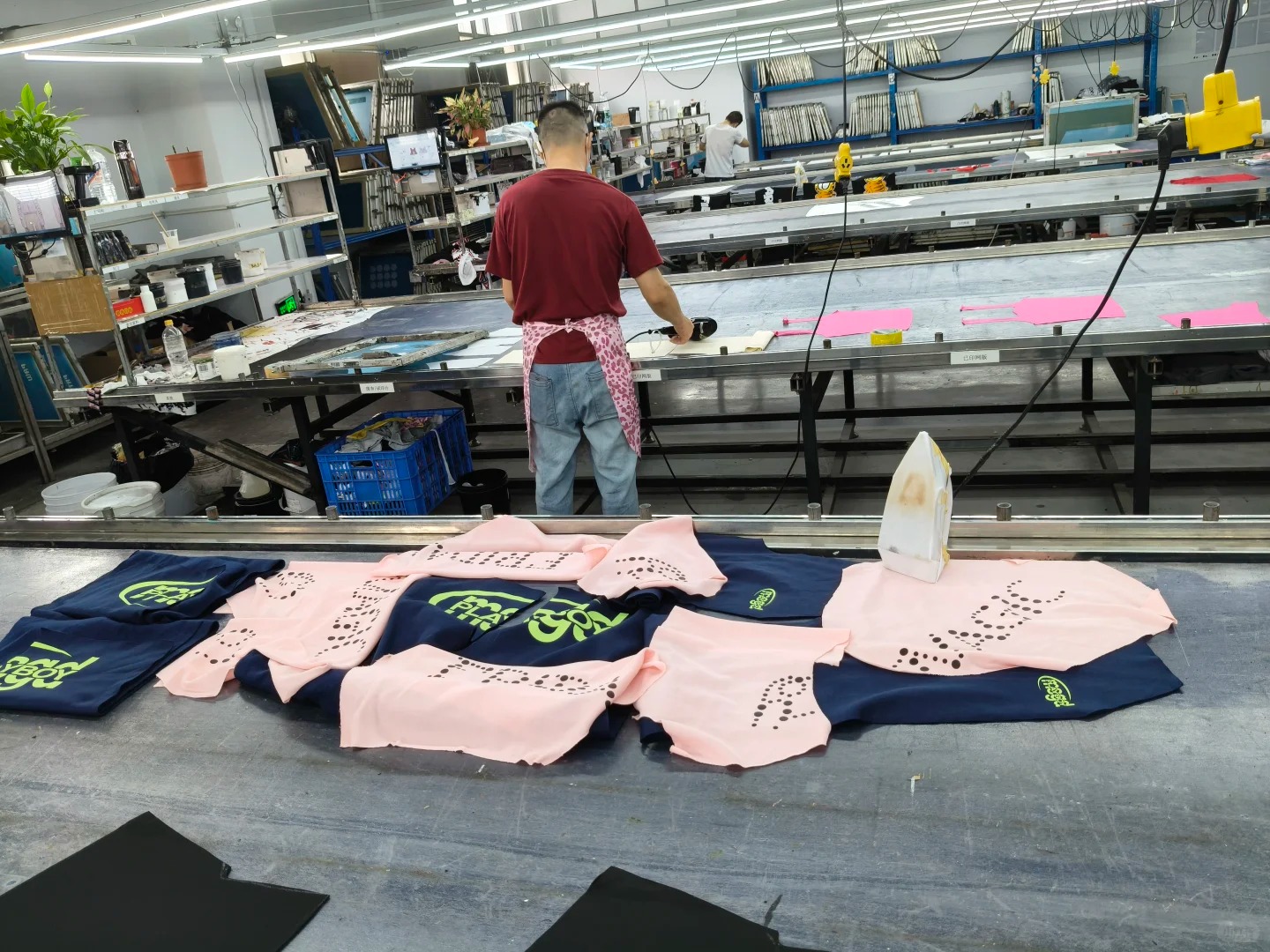
Screen printing production line at a garment printing factory
Digital printing offers a soft hand feel, while screen printing provides high color fastness.
The key performance characteristics of printed products include surface properties—such as hand feel (softness), tack, resistance, rub fastness, and wash fastness—as well as environmental safety, including the presence of formaldehyde, azo compounds, pH levels, carcinogenic aromatic amines, and phthalates. GB/T 18401-2003, “National Technical Specifications for the Basic Safety of Textile Products,” sets forth explicit requirements for some of the items listed above.
In traditional screen printing, with the exception of water-based and discharge printing, other types of printing tend to have a noticeable coating feel. This is due to the high resin content—which acts as a binder—in the ink formulation, as well as the relatively high ink coverage.
In contrast, digital printing produces virtually no coated feel; the prints are lightweight, soft, and have good tack. Even with pigment-based digital printing, the extremely low resin content in the formulation has virtually no impact on the fabric’s hand feel. Acid digital printing, reactive digital printing, disperse heat transfer printing, and disperse direct-to-fabric digital printing are even more free of a coated feel and do not affect the original fabric’s hand feel.
In both traditional water-based printing inks and pigment-based digital printing inks, resins serve as binders. On one hand, they enhance the adhesion between the coating and the fabric, preventing cracking and peeling after washing; on the other hand, resins encapsulate pigment particles, making them resistant to color loss through friction. Traditional water-based printing inks and pastes contain 20% to 90% resin, typically 70% to 80%, whereas digital printing inks—specifically pigment-based digital printing inks—contain only 10% resin. It is evident that, theoretically, the rub fastness and soap wash fastness of digital printing would be inferior to those of traditional printing. In fact, without proper post-treatment, the rub fastness of digital printing is indeed poor, particularly wet rub fastness. Although the soap wash fastness of digital printing sometimes passes testing according to GB/T 3921-2008 “Textiles—Color Fastness Tests—Soap Wash Fastness,” it still falls short compared to the wash fastness of traditional printing.
Without specific post-treatment, the rub fastness of digital printing is indeed poor, particularly wet rub fastness. The soap wash fastness of digital printing still falls short of the wash fastness of traditional printing. Currently, further exploration and breakthroughs are needed in the areas of rub fastness and soap wash fastness for digital printing.
Digital Printing Equipment Is Expensive
There are three main types of printers used for digital printing. The first is a flatbed printer modified from an Epson desktop model, such as the Epson T50. These models are primarily used for small-format digital printing with pigment inks, and their purchase cost is significantly lower than that of other models.
The second type consists of printers equipped with Epson DX4/DX5/DX6/DX7 series inkjet printheads, with the DX5 and DX7 being the most common. Examples include the MIMAKI JV3-160, MUTOH 1604, MUTOH 1624, EPSON F7080, and EPSON S30680. The purchase cost for each of these models is approximately 100,000 yuan. Currently, the market price for a DX4 printhead is 4,000 yuan each, for a DX5 printhead it is over 7,000 yuan each, and for a DX7 printhead it is 12,000 yuan each.
Third, industrial inkjet digital printing machines, including representative models such as Kyocera industrial printhead digital printing machines, Seiko SPT printhead digital printing machines, Konica industrial printhead digital printing machines, and SPECTRA industrial printhead digital printing machines, generally have a high purchase cost. The market price for a single printhead from any of these brands is over 10,000 yuan, and each printhead can only print one color. This means that to print four colors, a single machine must be equipped with four printheads, resulting in extremely high costs.
Consequently, digital textile printing equipment is extremely expensive, and inkjet printheads—as the primary consumables for digital inkjet printers—are also prohibitively costly. While the market price of digital printing ink is indeed much higher than that of traditional printing materials, the printing area covered by 1 kilogram of digital ink is incomparable to that of 1 kilogram of traditional ink. Therefore, when comparing costs in this regard, one must consider factors such as the type of ink used, specific printing requirements, and printing processes.
In traditional screen printing, the screen and squeegee are consumables when printing by hand, making labor costs more significant. Among traditional printing machines, imported octopus-style and oval-frame screen printing machines are more expensive than domestic models; however, domestic models are becoming increasingly sophisticated and can meet production requirements. When compared to inkjet printers, their purchase and maintenance costs are significantly lower.
Screen Printing Needs to Improve Environmental Sustainability
In terms of environmental protection, the environmental pollution caused by traditional screen printing is primarily manifested in the following aspects: the production process generates significant amounts of wastewater and waste ink; the printing process also requires the use of certain harmful solvents, and in some cases even plasticizers (thermosetting inks may contain environmentally unfriendly plasticizers), such as printing water, degreasing oil, and white spirit; In their daily work, screen printing operators inevitably come into contact with chemical solvents, adhesives, toxic cross-linking agents (catalysts), and chemical dust, which can adversely affect their health.
In digital printing, waste liquids are generated only during the pre-treatment sizing and post-treatment washing processes, while the inkjet printing process itself produces very little waste ink. Overall, the sources of pollution are fewer than in traditional screen printing, resulting in a smaller impact on the environment and the health of those exposed.
Summary
Digital printing is characterized by its wide range of compatible substrates, vibrant colors, intricate patterns, pleasant texture, and strong environmental friendliness. However, its drawbacks include the high cost of inkjet printers, as well as high consumable and maintenance expenses. It is difficult to improve the washfastness and rubfastness of digital printing products; developing stable white ink is challenging, which limits the quality of printing on black and dark fabrics; due to the limitations of inkjet printheads, it is difficult to develop inks capable of producing special effects; and the printing process sometimes requires pre- and post-treatment, making it more complex than traditional printing. These are the current disadvantages of digital printing.
For traditional screen printing to achieve steady growth in today’s printing industry, the following key points must be addressed: improving the environmental sustainability of printing inks and controlling environmental pollution during production; refining existing special printing effects and developing new ones to lead industry trends; keeping pace with the 3D trend to create a variety of 3D printing effects; While maintaining the wash and rub fastness of printed products, develop digital-like printing effects in conventional screen printing that are lightweight and have a smooth, non-textured feel; develop wide-format printing solutions and continuously improve printing efficiency and production capacity, ideally by establishing a printing production line platform; simplify printing equipment, reduce consumable costs, improve the return on investment for printing, and strengthen competitive advantages against digital printing.
Digital printing and screen printing each have their own strengths and weaknesses. At present, digital printing cannot yet replace screen printing.