 MHQ Hoodies

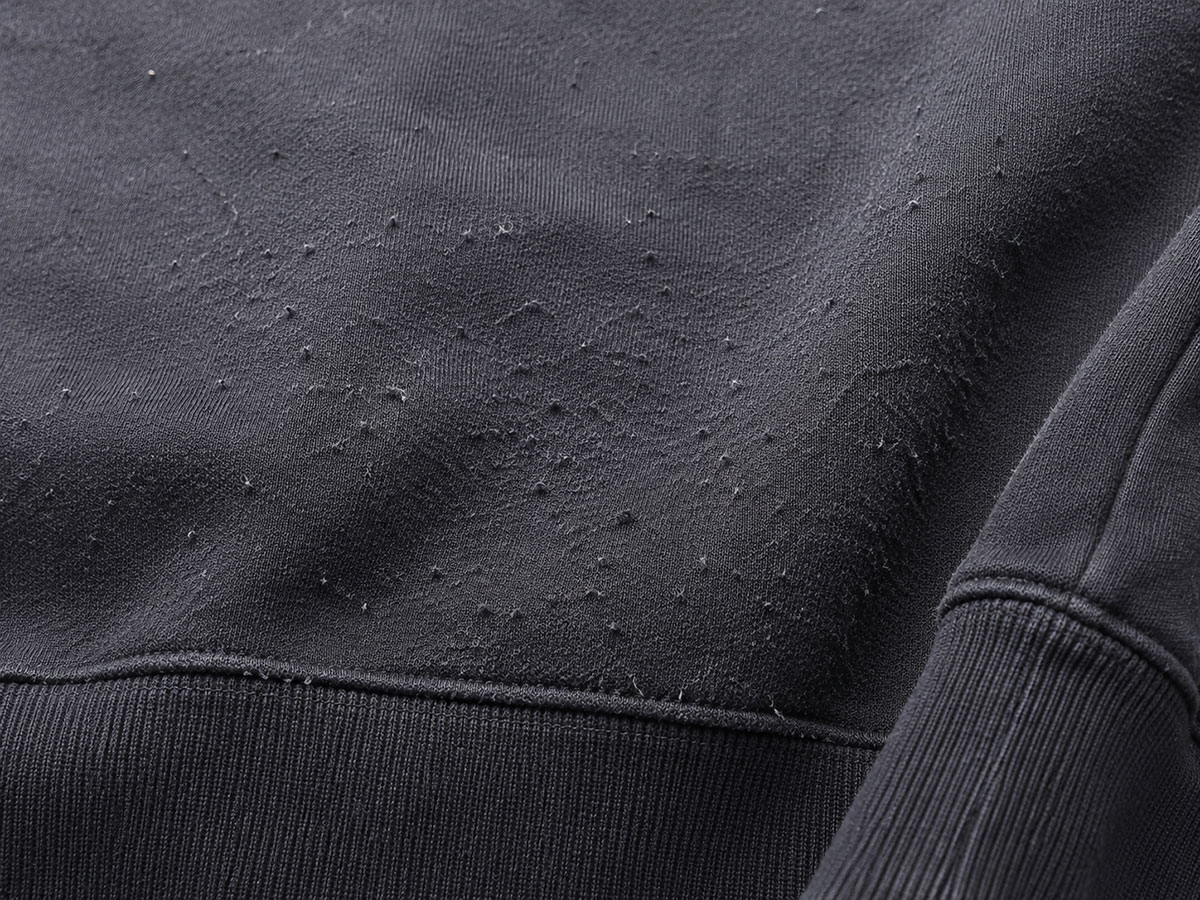
Pilling in sweatshirts refers to the formation of small fiber balls on the fabric surface during wear or washing. This occurs when fiber ends are exposed through mechanical friction and become tangled into tiny clusters. Pilling not only affects the garment’s appearance but also reduces the overall wearing comfort and experience.
Although many consumers believe that “100% cotton does not pill,” real-world observations show that some cotton sweatshirts can still develop pilling. Therefore, understanding the mechanism of pilling and implementing effective production control measures is essential for improving the overall quality of sweatshirt products.
The Three Stages of Pilling
The pilling process can be divided into three continuous stages.
The first stage is fuzz formation. During wear or washing, repeated friction causes surface fibers to be pulled out of the fabric, creating loose fuzz on the surface.
The second stage is entanglement. These protruding fibers gradually intertwine with each other, forming small, compact fiber clusters. Fibers with higher strength and toughness are more likely to entangle and less likely to break or fall off.
The third stage is pill formation. Under continued friction, these clusters become more compact and eventually develop into firm pills that remain attached to the fabric surface.
The Effect of Fiber Types on Pilling
Different fiber types have a significant impact on pilling behavior.
Synthetic fibers such as polyester and nylon have high strength and good elasticity. Once pills form, they are less likely to break or fall off, which leads to more stable and persistent pilling.
Among natural fibers, 100% cotton generally has lower fiber strength. After pilling occurs, fibers are more likely to break or detach, so the overall degree of pilling is relatively lighter, although it is not completely immune to pilling.
Blended fabrics are the most complex case. For example, in polyester-cotton blends, polyester and cotton fibers tend to entangle with each other. The polyester fibers help stabilize the pill structure, while the cotton fibers contribute surface fuzz, making pilling more severe overall.
Other Contributing Factors
In terms of yarn structure, yarns with lower twist and a looser construction are more prone to fiber ends protruding from the surface. Short-staple yarns are also more susceptible to pilling compared to filament yarns.
From the perspective of fabric construction, knitted sweatshirt fabrics are relatively loose in structure and therefore more likely to pill than tightly woven fabrics.
Regarding usage conditions, frequent friction with backpacks or outerwear, as well as prolonged machine washing cycles or high water temperatures, can all accelerate the pilling process.
Technical Measures to Control Pilling in Production
Controlling pilling at the source
The first approach is to use long-staple cotton, such as 100% long-staple cotton with a fiber length of 35 mm or above. This reduces the number of fiber ends in the yarn, thereby lowering the risk of pilling.
The second approach is to use modified fibers, such as anti-pilling polyester or low-stretch viscose. These engineered fibers reduce fiber cohesion and durability in a way that makes any formed pills more likely to break off and detach from the fabric surface.
Improving Yarn Compactness
During the spinning process, the primary measure is to increase yarn twist by using high-twist yarns. In terms of technical parameters, the twist level for strong-twist cotton yarn is typically controlled between 1,000 and 1,400 twists per meter. Higher twist levels result in a more compact yarn structure, making it more difficult for fiber ends to protrude.
Another effective approach is the use of compact spinning technologies, such as compact siro spinning. For key yarns like jersey yarns and fleece yarns, 100% long-staple cotton combined with compact siro spinning can be used in production. This process significantly reduces yarn hairiness and produces a cleaner, smoother fabric surface.
In the weaving stage, fabric density can be increased as a preventive measure against pilling by adopting a high-density construction. Typically, yarn counts are selected in the range of Ne 26 to Ne 32. A denser structure helps firmly lock fibers in place, reducing the chance of fiber exposure on the surface.
Removing or Stabilizing Surface Fuzz
In the finishing stage, several methods can be used to reduce or control surface fuzz.
Singeing is a traditional and highly effective method. A double-singeing process is recommended. Specifically, the greige fabric is first singed after opening the fabric width, followed by dyeing, and then a second singeing after dyeing. This sequence effectively burns off protruding fibers on the fabric surface.
Bio-polishing technology is also widely applied, typically using cellulase enzymes. Pre-treatment before dyeing helps break down protruding fibers, resulting in a cleaner and smoother fabric surface.
Anti-pilling finishing agents are another option, such as glyoxal-based resins and other functional auxiliaries. These agents improve surface smoothness and reduce fiber entanglement, although their wash durability is relatively limited.
In addition, mechanical pre-finishing methods can be used, such as laser treatment or shearing equipment to remove surface fuzz in advance, with abrasion tests conducted afterward to verify performance.
Integrated Prevention Strategy and Performance Evaluation
In actual production, a single method is rarely sufficient to fully eliminate pilling. The most effective approach is to combine multiple techniques to establish a systematic control framework.
A recommended integrated process route is: selecting long-staple cotton as the raw material, combined with high-twist yarn or compact spinning technology, followed by either singeing or enzymatic treatment in the finishing stage. This end-to-end strategy—covering raw material selection, spinning, and finishing—can improve the pilling resistance rating of sweatshirts to Grade 3–4 (according to GB/T 4802.1–2008, where Grade 5 represents the best performance), making it suitable for mid-to-high-end apparel markets.
In addition, laboratory-based abrasion simulations such as the Martindale pilling test or pilling box method can be used to effectively evaluate performance and guide further process optimization.
It should be specifically noted that 100% cotton is not completely resistant to pilling; however, compared with synthetic fibers and blended fabrics, its pilling tendency is generally milder. The most effective approach is to use long-staple cotton as the raw material, combined with high-twist yarn or compact spinning technology, followed by singeing or enzymatic treatment.
By integrating multiple techniques in a systematic way, the anti-pilling performance of sweatshirts can be significantly improved, thereby meeting consumers’ expectations for high-quality apparel.