 MHQ Hoodies

If you are planning to start a clothing brand or customize apparel for corporate or group use, you will likely consult apparel wholesalers or manufacturers, or browse online B2B platforms such as Alibaba or Made-in-China. One confusing phenomenon quickly becomes apparent: products all labeled “100% cotton hoodies” can be quoted at $10USD by some suppliers, while others charge $20USD or even more.
This price disparity is especially pronounced in B2B sourcing. Behind it lies a complex combination of cost structures and value components rather than simple price arbitrage.
Using manufacturers based in China as an example, the following sections break down the true cost structure of producing a hoodie.
How Much Does It Cost to Make One Hoodie? To understand hoodie pricing, you must first understand every cost component involved in bringing a hoodie from concept to finished product.
Fabric Cost (Largest Component: Typically 35%–50%)
Fabric is the foundation of both quality and cost. Different fabric choices can result in several-fold cost differences.
Common Fabric Types
| Fabric Type | Description | Cost Impact |
|---|---|---|
| Basic cotton | Regular or recycled cotton, market mainstream | $3–4usd per meter |
| Combed cotton | Short fibers removed for smoother, more durable fabric | +10%–20% |
| Functional fabrics | CVC cotton (cotton/poly blend), polar fleece, sherpa fleece | +20%–30% |
| Premium options | Organic cotton, mercerized cotton | 1.5–2× regular cotton |
Fabric Weight (GSM) Matters
Fabric weight (grams per square meter) directly affects thickness, warmth, durability, and cost.
| Category | GSM Range | Characteristics | Cost Impact |
|---|---|---|---|
| Spring weight | 220–260g | Lightweight, breathable | Lower cost |
| Autumn/Winter standard | 280–320g | Market mainstream, balanced | Moderate |
| Heavyweight | 350g+ | Dense, warm, premium feel | Significantly higher |
Rule of thumb: every additional 20g of fabric weight increases fabric cost by approximately 5%–8%.
Accessories, Craftsmanship, and Printing Costs
Trims and production techniques often distinguish a standard hoodie from a premium one.
Zippers and Accessories
| Component | Typical Cost (RMB) | Notes |
|---|---|---|
| Standard resin zipper | 0.5–1 / pc | Basic durability |
| Mid-range metal zipper | 1.5–2.5 / pc | Improved feel |
| Branded zippers (e.g. YKK) | 3–5 / pc | Significantly better durability |
| Drawstrings, aglets, buttons | +0.5–2 / pc | Depends on quality |
Printing and Decoration Techniques
Screen Printing
Suitable for large, colorful designs
Setup fee + unit price model
Screen setup: RMB 100–300 (amortized)
Printing cost: RMB 0.5–1.5 per color per piece
Costs rise sharply beyond four colors
Embroidery
Suitable for logos and small, detailed graphics
Digitizing fee: RMB 150–500 (based on stitch count)
Unit cost: RMB 2–8 per piece
Complexity, size, and color count drive cost
Special Processes (Value-Added)
Flocking, foil stamping, reflective strips, fluorescent coatings, etc.
Add approximately RMB 3–15 per piece depending on complexity
Manufacturing and Labor Costs
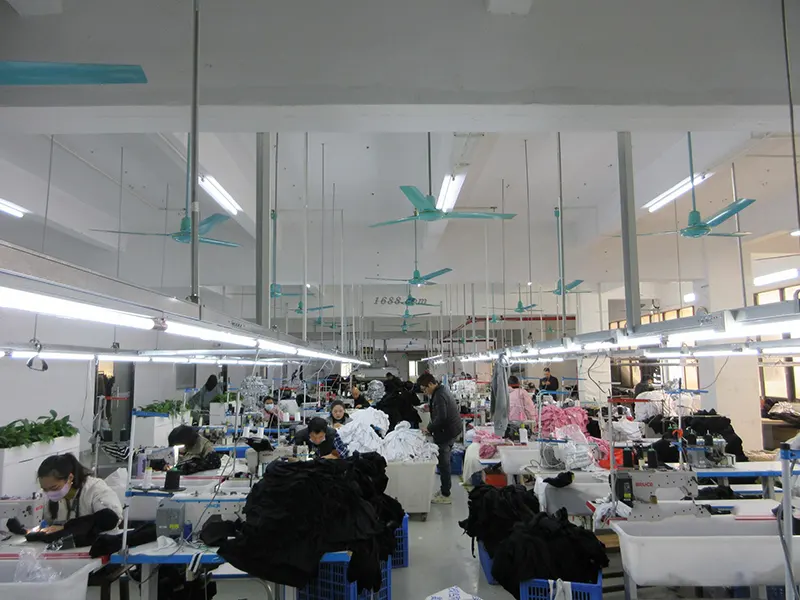
Manufacturing costs vary significantly by region and factory type in China.
| Region / Factory Type | Characteristics | Cost Implication |
|---|---|---|
| South & East China (Pearl River Delta, Yangtze River Delta) | Mature factories, skilled workers (RMB 6,000–8,000/month) | Higher labor cost, stable quality |
| Inland regions (Jiangxi, Hubei, Henan, Shandong, Hebei) | Lower wages (RMB 3,000–5,000/month) | Lower cost, less integrated supply chain |
| High automation factories | Automatic cutting, template sewing | High fixed cost, ideal for large orders |
| Small workshops | Flexible, labor-intensive | Suitable for small orders |
Reasonable Factory Profit Margin
A healthy manufacturing business requires a sustainable profit margin to operate and grow. Factory margins typically range from 5% to 15% of the ex-factory price, depending on order size, order stability, and long-term cooperation.
Minimum Order Quantity (MOQ)
In B2B custom apparel sourcing, MOQ is one of the most critical variables affecting unit price.
Why MOQs Exist
From the factory’s perspective:
Machine setup, line changes, and calibration all incur fixed time costs
Larger volumes allow costs to be spread more efficiently
Fabric suppliers also impose MOQs, raising unit costs for small purchases
Factories prioritize large orders to maximize capacity utilization
Common MOQ Thresholds
| Product Type | Typical MOQ |
|---|---|
| Solid-color basic styles | 100–300 pcs (mixed colors allowed, usually 50–100 pcs per color) |
| Printed or embroidered styles | 100–500 pcs (setup costs amortized) |
| Fully custom designs | 100–200 pcs+ (includes development cost) |
| Ready stock / relabeling | 50–100 pcs, sometimes mixed (higher unit price) |
Tiered Impact of MOQ on Unit Price
Example: a 320g combed cotton basic hoodie
| Order Quantity | Fabric Cost | Manufacturing Cost | Total Unit Cost | Reduction vs. 100 pcs |
|---|---|---|---|---|
| 100 pcs | RMB 42 | RMB 38 | RMB 88 | – |
| 500 pcs | RMB 38 | RMB 34 | RMB 80 | –10% |
| 1,000 pcs | RMB 35 | RMB 32 | RMB 75 | –14% |
| 3,000 pcs | RMB 32 | RMB 30 | RMB 70 | –20% |
When order volume increases from 100 to 1,000 units, the unit price drops by approximately 14%; at 3,000 units, the reduction can reach 20%. This explains why large-scale procurement enjoys significant pricing advantages.
Hidden Thresholds: Colors and Sizes
Beyond total quantity, buyers should also consider:
Per-color MOQs: Even if total quantity meets requirements, each color often has a minimum of 50–100 pieces
Size ratios: Factories typically require standard ratios (e.g. S : M : L : XL = 1 : 2 : 2 : 1)
Non-standard sizes: XXS or XXL may require higher minimums or incur surcharges
Conclusion
A hoodie may appear simple, but from cotton fields to the end consumer, it is the product of a highly coordinated supply chain. The essence of B2B custom apparel sourcing is finding the optimal balance among cost, quality, quantity, and risk.
Whether you are new to hoodie sourcing or looking to optimize an existing supply chain, we hope the framework and details provided here serve as a practical decision-making reference.